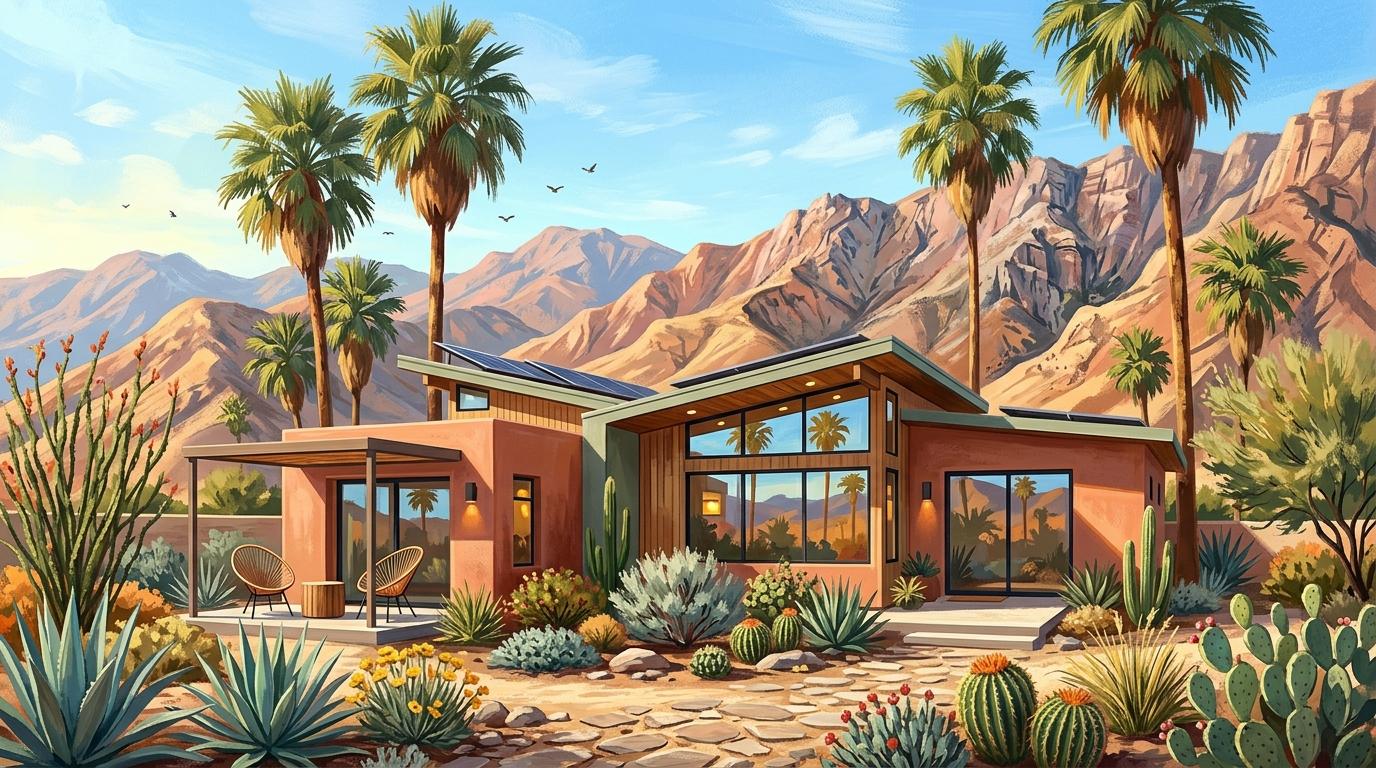
Executive Summary: The True Cost of Desert Sunshine
Living in Southern California's Coachella Valley is an unparalleled lifestyle experience. With more than 300 days of guaranteed annual sunshine, sweeping panoramic views of the San Jacinto and Santa Rosa mountain ranges, over 120 championship golf courses, and world-class dining from El Paseo to Palm Springs, Greater Palm Springs is widely celebrated as one of the country's premier resort destinations.
However, desert paradise comes with an undeniable climatic reality: summer heat. Between June and September, daytime temperatures across Palm Desert, La Quinta, Indio, and Cathedral City regularly climb between 108°F and 118°F, occasionally touching 120°F during mid-summer heat domes.
For prospective homebuyers, retirees, and relocators evaluating properties across the Coachella Valley, one critical question inevitably surfaces during every financial consultation: What will it actually cost to keep my desert home comfortably cool during the peak summer months?
The answer depends almost entirely on when and how the home was built. Homebuyers purchasing an older resale home constructed in the 1970s, 1980s, 1990s, or even early 2000s are frequently shocked to receive peak summer electric bills ranging from $600 to over $1,200 per month. In contrast, buyers of modern new construction homes—built to California's stringent Title 24 Energy Efficiency Standards and equipped with high-SEER2 multi-zone HVAC systems, radiant barrier roof sheathing, dual-pane Low-E366 glass, and smart climate automation—enjoy crisp, consistent interior comfort for just $180 to $350 per month in identical desert conditions.
Over a five-to-ten-year ownership horizon, this thermal efficiency gap represents $25,000 to over $60,000 in pure utility savings, not counting the avoided $15,000 to $25,000 emergency expense of replacing a blown air conditioning unit in the middle of a July heat wave.
With more than two decades in large-scale builder operations, subdivision development, and new construction sales—closing over 1,000 homes and generating more than $200 million in career sales volume—Broker Stacy King (CA DRE #01458045) provides desert homebuyers with the unvarnished facts, building science insights, and dedicated buyer advocacy needed to secure maximum comfort and long-term financial value.
Summer Cooling Bill Reality Check (June – September)
- Older Resale Home (1980–2005, 2,200 sq. ft.): $650–$1,200/mo utility bill, aged SEER 10–12 condenser, 150°F+ uninsulated attic, leaky ducts losing 25–40% cool air, single-pane clear glass, and constant compressor strain.
- Modern New Build (D.R. Horton, 2,200 sq. ft.): $180–$350/mo utility bill, high-efficiency SEER2 multi-zone system, radiant barrier + R-38 insulation, mastic-sealed R-8 ducts (<4% leakage), dual-pane Low-E glass, and smart connected automation.
- 10-Year Ownership Impact: $25,000 to $60,000+ in pure utility savings, plus $15,000–$25,000 in avoided emergency HVAC replacement expenses.
The Anatomy of High Utility Bills: Why Older Resale Homes Hemorrhage Energy
To understand why new construction performs so radically better in the desert, one must examine the thermal vulnerabilities inherent in older Coachella Valley homes.
When walking through an older golf course condo or mid-century ranch home in Rancho Mirage, Palm Desert, or Palm Springs, buyers are often captivated by architectural charm, vaulted post-and-beam ceilings, and large picture windows. However, homes built before modern energy codes suffer from five critical thermal flaws that cause excessive utility costs.
1. The Attic 'Oven Effect' (150°F+ Thermal Loads)
In older desert homes, dark concrete or asphalt roof tiles absorb intense solar radiation. Without a reflective barrier beneath the roof decking, that heat transfers directly into the attic space, driving attic temperatures to 150°F to 165°F on summer afternoons. Compressed R-11 to R-19 insulation allows this heat reservoir to radiate downward into living areas.
- •Attic temperatures routinely reach 150°F – 165°F during summer afternoons.
- •Degraded insulation allows continuous downward thermal transfer into living spaces.
- •Forces AC compressors to run continuously just to prevent indoor temperatures from rising.
2. Leaky, Aged Ductwork in Scorching Attic Spaces
In many 1980s and 1990s homes, flexible duct runs have dry-rotted, sagged, or developed compromised tape seals. Testing reveals older desert duct systems routinely lose 25% to 40% of their conditioned cold air directly into the superheated attic before it ever reaches living areas.
- •25% to 40% of chilled air lost directly into superheated attic spaces.
- •Return air leaks pull 150°F attic air into the air handler.
- •Massive electrical energy expended just bringing overheated attic air down to room temperature.
3. Single-Pane Aluminum Windows & Solar Heat Gain
A single pane of clear glass offers an R-value of approximately R-1. In full desert sunlight, a single-pane window acts as a thermal amplifier, transferring over 70% of radiant solar heat (SHGC > 0.70) directly into carpets, furniture, and walls while aluminum frames conduct heat straight into wall framing.
- •SHGC > 0.70 allows more than 70% of radiant solar heat inside.
- •Conductive aluminum frames act as interior thermal radiators.
- •Accelerates UV fading on flooring, upholstery, and fine art.
4. Low-SEER Single-Stage Compressors & Phased-Out Freon
Resale homes built 15 to 25 years ago typically operate on 10 to 12 SEER units with single-stage compressors that draw massive electrical amperage restarting dozens of times per day. Many still rely on phased-out R-22 Freon ($150 to $250+ per pound).
- •SEER 10–12 single-stage compressors draw maximum amperage on every restart cycle.
- •High mechanical failure rates during peak 115°F desert heat waves.
- •Phased-out R-22 Freon makes routine repairs and recharges prohibitively expensive.
5. Building Envelope Infiltration & Thermal Bridging
Older homes were constructed without continuous air barrier wraps, modern mastic sealants, or tight gasket seals around electrical boxes, plumbing penetrations, and recessed lighting fixtures, allowing desert heat to continuously infiltrate wall cavities.
- •Unsealed electrical outlets, plumbing penetrations, and can lights leak heat.
- •Absence of continuous house wraps allows superheated air infiltration.
- •Chilled indoor air escapes through drafty doors and unsealed framing joints.
Modern Building Science: How New Construction Conquers 115°F Desert Heat
Modern new construction homes built by premier national homebuilders like D.R. Horton ('America's Builder') are engineered from the ground up as tightly integrated, high-performance thermal envelopes.
Under California's Title 24 Building Energy Efficiency Standards—the most rigorous residential energy code in the United States—every structural element is optimized to block solar heat gain, retain conditioned air, and minimize electrical consumption.
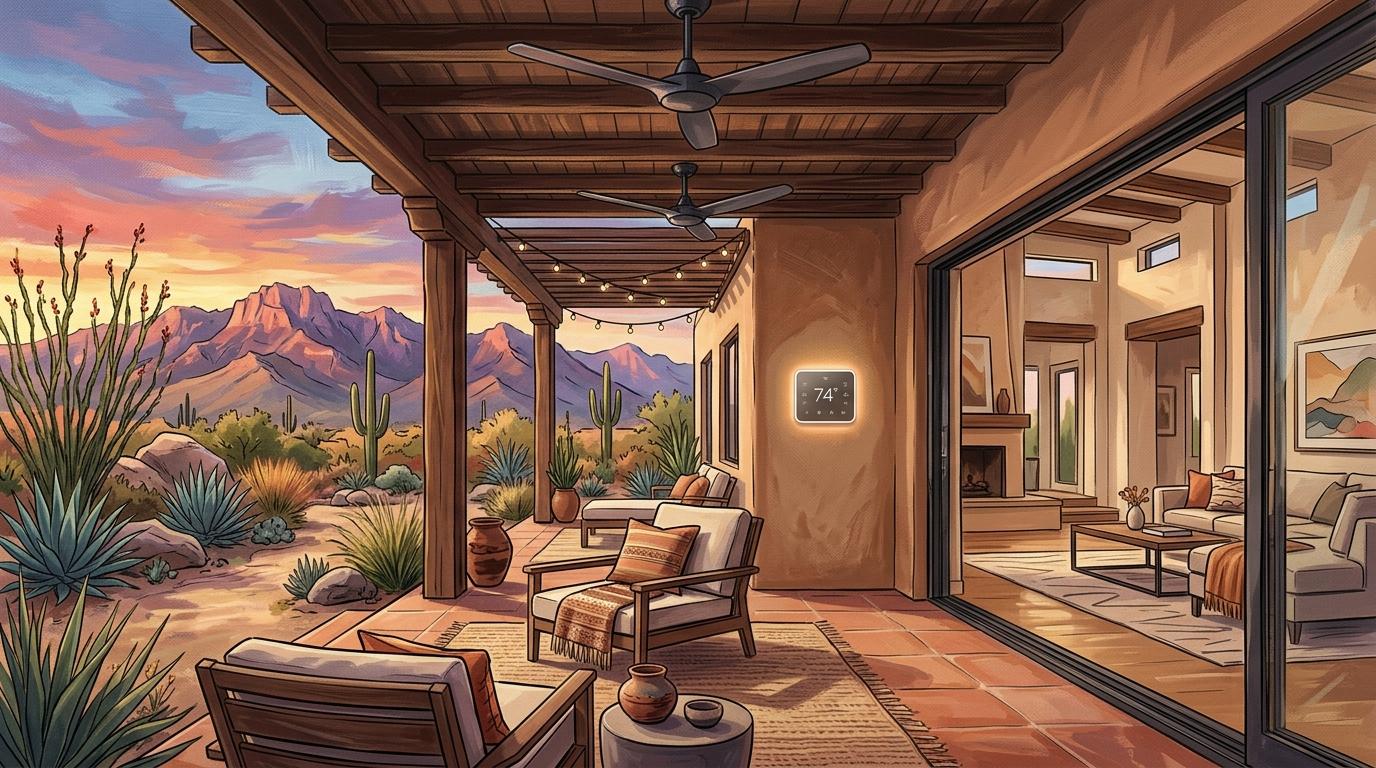
Artistic view of energy-efficient desert indoor-outdoor living with shaded California Room, smart thermostat automation, and Santa Rosa mountain vistas.
The 6 Pillars of Modern Desert Building Science
- 1. Radiant Roof Barrier: Reflects up to 97% of radiant solar heat, lowering attic temperatures by 35°F to 45°F.
- 2. Dual-Pane Low-E366 Glass: Low SHGC (<0.22) with argon gas thermal fill and non-conductive vinyl frames.
- 3. High-SEER2 Multi-Zone HVAC: Variable-speed compressors and ECM DC blower motors that slash peak electrical consumption by up to 50%.
- 4. Mastic-Sealed R-8 Ductwork: HERS-certified <4% duct leakage testing guarantees cold air reaches every living space.
- 5. America's Smart Home® Connected Tech: Honeywell smart thermostats with remote pre-cooling and Time-of-Use rate optimization.
- 6. Continuous Air Sealing & R-38 Blown Insulation: Blower-door tested building envelopes that eliminate thermal bypass gaps.
Radiant Barrier Roof Sheathing: Lowering Attic Heat by 40°F
Engineered wood panels bonded with highly reflective aluminum foil reflect 97% of radiant solar heat away from the attic. On a 115°F July day when resale attics hit 160°F, radiant barrier attics stay at 115°F–125°F.
- •Blocks up to 97% of radiant solar heat transfer.
- •Reduces attic temperatures by 35°F to 45°F during peak summer.
- •Protects ductwork and blown attic insulation from thermal degradation.
Dual-Pane Low-E Vinyl Windows with Argon Gas
Microscopic metallic coatings reflect long-wave infrared heat while admitting abundant natural daylight. Sealed argon gas chambers and vinyl frames stop exterior heat from entering your living space.
- •Solar Heat Gain Coefficient (SHGC) under 0.22 blocks 78%+ of solar heat.
- •Argon gas fill insulates significantly better than ambient air.
- •Multi-chamber vinyl frames provide a complete thermal break.
High-Efficiency SEER2 Multi-Zone HVAC Systems
Equipped with variable-speed compressors that modulate smoothly between 30% and 100% capacity, ECM blower motors, and multi-zone dampers that cool occupied living areas independently.
- •15 to 16+ SEER2 ratings tested under strict real-world static pressure.
- •Variable-speed compressors maintain precision temperature within 0.5°F.
- •Multi-zone controls eliminate the waste of cooling unoccupied rooms.
America's Smart Home® Connected Climate Tech
Honeywell smart touchscreen thermostats enable remote pre-cooling, Time-of-Use (TOU) scheduling to avoid expensive 4–9 PM peak utility rate windows, and vacation standby modes.
- •Remote smartphone pre-cooling before arriving from the airport or LA.
- •Time-of-Use smart scheduling to pre-cool on off-peak utility rates.
- •Vacation standby modes maintain home protection with minimal wattage.
Real-World Utility Cost Analysis: Resale vs. New Construction Financial Models
To see the dramatic financial advantage of modern building science, let us examine an empirical utility cost comparison modeling a standard 2,200 sq. ft. home across Southern California Edison (SCE) and Imperial Irrigation District (IID) service territories in the Coachella Valley.
During peak summer months (June through September), an older resale home averages $790 to $1,180 per month in electric utility bills. In contrast, a modern D.R. Horton new build averages just $230 to $325 per month under identical climatic conditions—saving homeowners $560 to $855 each month during the summer season.
On an annual basis, older resale homes generate approximately $6,190 in total electric utility costs, compared to just $1,895 for modern new construction—putting $4,295 back into the homeowner's pocket every single year.
Stacy King's Financial Insight: The 'Hidden Mortgage' of Resale Utilities
- Utility bills represent a secondary mortgage payment in extreme desert climates.
- Saving $4,295 per year ($358/month) on electricity in a new build is the financial equivalent of having $50,000 to $60,000 in additional purchasing power at prevailing mortgage rates.
- 10-Year Cumulative Savings: $42,950 in lower utility bills + $20,000+ in avoided emergency AC replacements = $63,750 to $69,750 in net buyer savings.
- Zero out-of-pocket repair costs under 10-year builder structural and mechanical warranties.
"When evaluating home affordability, look beyond principal and interest. In the Coachella Valley, utility bills represent a secondary mortgage. New construction saves you $4,000+ per year while keeping you effortlessly cool."
— Stacy King, Real Estate Broker
Desert Community Spotlight: 4 Energy-Optimized D.R. Horton Neighborhoods
To experience modern desert energy efficiency firsthand, prospective homebuyers should explore the four flagship D.R. Horton gated communities currently selling across Greater Palm Springs. Each neighborhood showcases cutting-edge Title 24 construction, radiant barriers, America's Smart Home® tech, and climate-optimized architectural layouts.
1. The Collection at Sage — Palm Desert, CA
Located at 73298 Warhol Lane in central Palm Desert minutes from El Paseo luxury shopping. Priced from $626,162 with 1,750 to 2,312 sq. ft. (3–4 Beds / 2–3 Baths / 2-Car Garage).
- •Pricing: From $626,162 | Sizes: 1,750–2,312 sq. ft. | 3–4 Beds | 2–3 Baths
- •Energy Features: SEER2 dual-zone climate control, radiant barrier decking, Low-E glass
- •Amenities: Gated entrance, private resident clubhouse, resort pool, spa, fitness center
- •Location: Minutes from El Paseo shopping, dining, and Eisenhower Health
2. Dolfina — Indio, CA
Located at 49140 Heron Place in fast-growing South Indio near the Empire Polo Club. Priced from the $610s with 1,890 to 2,537 sq. ft. (4–5 Beds / 3–4 Baths / 2-Car Garage).
- •Pricing: From the $610s | Sizes: 1,890–2,537 sq. ft. | 4–5 Beds | 3–4 Baths
- •Energy Features: Multi-zone smart thermostats, attic thermal barrier, tight duct sealing
- •Floor Plans: Generous 4–5 bedroom layouts ideal for families and vacation hosting
- •Location: Rapidly growing South Indio near festival grounds and championship golf
3. The Enclave at Capistrano — La Quinta, CA
Located at 57-435 Crown Valley Court near PGA West and Old Town La Quinta. Priced from the low $700s with 2,348 to 3,003 sq. ft. (3–4 Beds / 2.5–3.5 Baths / 2 to 3-Car Garage).
- •Pricing: From low $700s | Sizes: 2,348–3,003 sq. ft. | 3–4 Beds | 2.5–3.5 Baths
- •Energy Features: Covered California Rooms for passive wall shading, central multi-stage HVAC
- •Architecture: Single-story luxury living with panoramic Santa Rosa mountain backdrops
- •Location: Prestigious La Quinta near PGA West, Old Town cafes, and hiking trails
4. The Collection at Campanile — Cathedral City, CA
Located at 232 Via Genova just minutes from downtown Palm Springs and PSP airport. Priced from $587,199 with 1,913 to 2,929 sq. ft. (3–5 Beds / 2–4 Baths / 2-Car Garage).
- •Pricing: From $587,199 | Sizes: 1,913–2,929 sq. ft. | 3–5 Beds | 2–4 Baths
- •Energy Features: Low-E366 window packages, smart thermostats, thermal barrier sealing
- •Amenities: Community swimming pool, spa, tot lot, private park, and walking trails
- •Location: 10 minutes to Palm Springs International Airport and downtown nightlife
Stacy King's Strategic Buyer Insights: Passive Solar Design & Lot Orientation
Beyond mechanical HVAC equipment, the physical orientation of your home on its desert lot exerts a massive influence on summer cooling performance. During her 20+ years in builder operations and new home development, Broker Stacy King has guided over 1,000 buyers through strategic lot selection.
A shaded exterior wall surface can be up to 30°F cooler than a wall exposed to direct desert sunlight, drastically reducing heat transfer into interior living rooms and primary suites. Selecting a home with an integrated covered California Room or an optimal north-facing rear patio orientation maximizes outdoor enjoyment while keeping cooling costs at their absolute minimum.
Desert Lot Orientation Strategy Guide
- North-Facing Rear: Gentle ambient daylight, zero direct afternoon solar heat gain, and the coolest summer patio profile.
- South-Facing Rear: Consistent year-round natural illumination, warm winter afternoon sun, and moderate summer cooling impact.
- West-Facing Rear: Intense afternoon solar gain where an integrated covered California Room is essential as a thermal heat buffer, rewarded by spectacular Santa Rosa sunset mountain vistas.
- Microclimate Breezes: Strategic window alignment captures evening desert wind channels from the San Gorgonio Pass for natural cross-ventilation.
The Critical Advantage: Touring New Construction with Independent Broker Stacy King
When touring new home communities across Palm Desert, Indio, La Quinta, or Cathedral City, buyers often walk into sales galleries unrepresented, assuming the friendly on-site sales agents represent their interests.
On-site sales agents represent the builder. Their fiduciary duty is to protect the builder's profit margins, uphold builder contract terms, and enforce corporate pricing.
Having Broker Stacy King (CA DRE #01458045) represent you costs you zero dollars. Builders pay broker compensation from separate corporate marketing budgets. Crucially, builders will not lower the home price if you tour unrepresented—unrepresented buyers simply forfeit expert representation while paying the exact same purchase price.
Why Buy With Broker Stacy King?
- Free Buyer Representation: California builders pay Stacy King's broker commission—you receive 20+ years of expert advocacy at zero cost.
- Contract & Clause Deciphering: Navigate 100-page builder agreements, deposit schedules, and warranty clauses with an insider.
- Optimal Lot & Energy Selection: Identify homesites with superior solar orientation and maximum shading advantages.
- Independent Walkthroughs & HERS Audits: Pre-drywall inspections, insulation checks, and blue-tape punch-list advocacy.
- Crucial First Visit Rule: Call or text Stacy King at 760-902-6907 before visiting any sales office or registering online to secure representation.
"Having an independent broker who spent 20+ years inside builder operations is the ultimate safeguard for desert buyers. We protect your deposit, negotiate incentives, and verify construction quality at zero cost to you. Give King a Ring!"
— Stacy King, Real Estate Broker
Frequently Asked Questions (FAQ)
Here are answers to the most common questions prospective buyers ask regarding summer cooling costs, SEER2 standards, and new home construction in the Coachella Valley.
How much can I realistically expect to save on summer cooling in a new Coachella Valley home?
A modern 2,000 to 2,500 sq. ft. new construction home typically costs between $180 and $350 per month to cool during peak summer months (June through September). In comparison, an identically sized resale home built in the 1980s or 1990s typically costs between $650 and $1,200+ per month. Over a typical summer season, you can expect to save $2,000 to $3,500+, yielding over $25,000 to $35,000 in utility savings every 10 years.
What makes SEER2 different from older SEER ratings on resale homes?
SEER2 is the new federal efficiency standard enacted in 2023. It utilizes more rigorous testing protocols (M1 testing) that simulate real-world static pressure inside residential ductwork. A modern 15 to 16+ SEER2 unit delivers significantly higher actual cooling output per kilowatt of electricity than older 10 to 12 SEER units, particularly in extreme desert conditions above 105°F.
Do all D.R. Horton homes include radiant barrier roof sheathing?
Yes. D.R. Horton homes constructed in the Coachella Valley division feature radiant barrier roof sheathing as part of their comprehensive Title 24 energy package. This reflective layer blocks up to 97% of radiant solar heat, lowering attic temperatures by 30°F to 45°F during scorching summer heatwaves.
Are solar panels required on new homes in California?
Under California Title 24 standards, newly constructed single-family homes require photovoltaic (PV) solar systems sized to offset a portion of the home's annual electricity usage. Builders offer straightforward solar lease, power purchase agreement (PPA), or purchase options. Combined with radiant barriers and SEER2 HVAC, solar reduces summer electric bills even further.
What is the 'First Visit' rule when touring new construction communities?
To have your own dedicated, independent broker represent you for free, your broker must accompany you on your first visit to the sales office or register you in advance. If you visit a sales gallery alone and sign a guest card without declaring your broker, the builder will classify you as an unrepresented buyer and permanently bar your broker from representing you on that transaction. Always call Stacy King at 760-902-6907 before touring!
Schedule Your Private VIP Tour with Broker Stacy King
Are you ready to explore Greater Palm Springs new construction and discover the remarkable comfort, quality, and low-cost energy efficiency of modern desert living?
Whether you are seeking the vibrant lock-and-leave lifestyle at The Collection at Sage in Palm Desert, family-friendly spaciousness at Dolfina in Indio, single-story luxury at The Enclave at Capistrano in La Quinta, or central convenience at The Collection at Campanile in Cathedral City, Broker Stacy King is ready to guide you home.
Showing hours are Wednesday through Sunday, 10:00 AM – 6:00 PM. Call 760-902-6907 or email agentstacyking@gmail.com today to register for your private VIP community walkthrough at zero cost to you!
"Give King a Ring at 760-902-6907 before visiting any Coachella Valley sales office to secure your 100% free buyer representation!"
— Stacy King, Real Estate Broker

Stacy King
DRE 01458045
Real Estate Broker & New Home Specialist
CA DRE #01458045 | Over 20 Years Experience | 1,000+ Homes Sold
Stacy King brings over two decades of new construction leadership, builder contract expertise, and localized desert real estate knowledge to help buyers find their dream home in Greater Palm Springs.