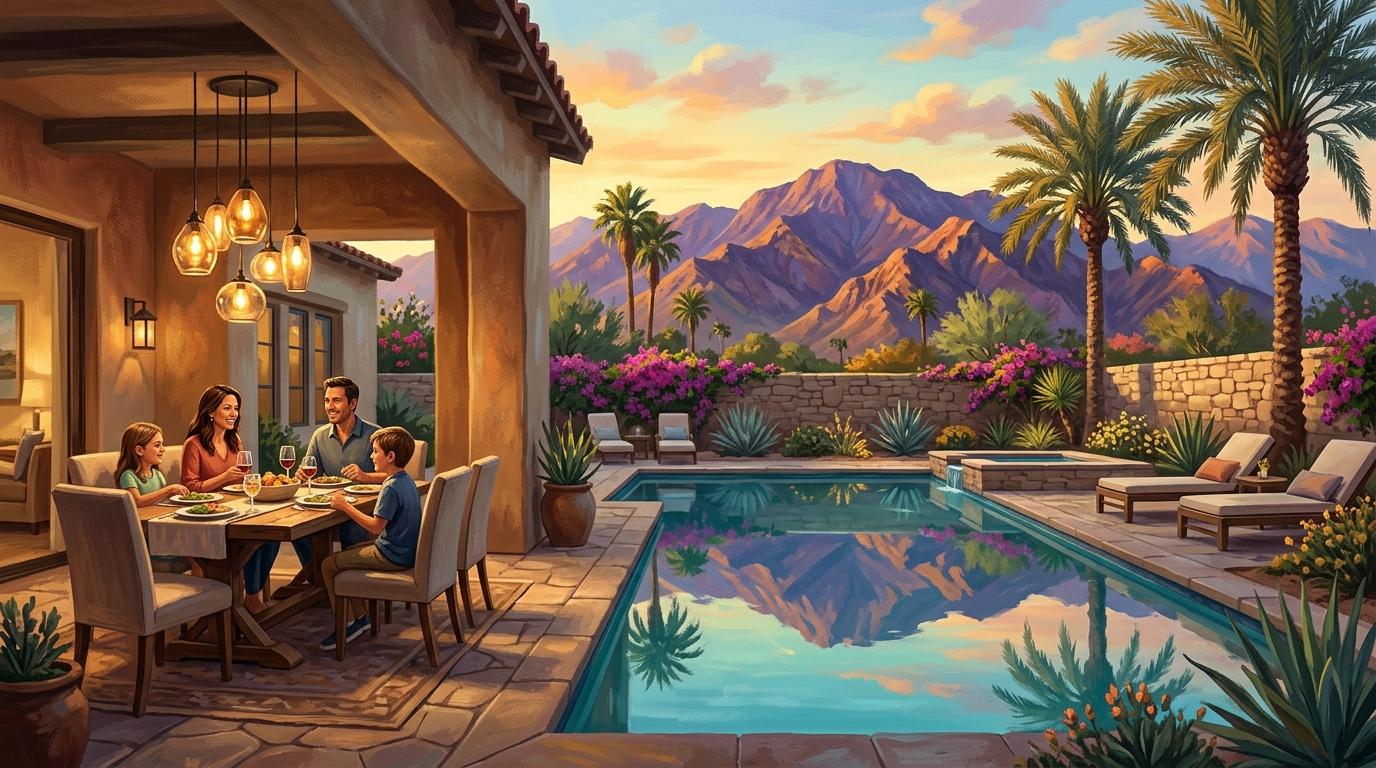
Executive Summary: The Aerodynamics of Desert Living
The Coachella Valley is an arid paradise framed by majestic mountain ranges. However, the unique geography of the valley—positioned between the coastal marine systems of Southern California and the low desert basin—creates a natural wind channel through the San Gorgonio Pass.
In older, unmanaged desert subdivisions, seasonal spring winds and afternoon thermal breezes can disrupt outdoor living:
How do modern gated master plans use civil engineering, perimeter masonry walls, and botanical landscaping berms to create calm, sheltered outdoor living spaces year-round?
In contrast to older open-grid neighborhoods, brand-new master-planned communities by D.R. Horton ('America's Builder') are engineered from the initial civil grading phase to manipulate local airflow. By combining solid masonry perimeter walls, multi-layered botanical windbreaks, curved road geometry, and recessed California Rooms, these communities create sheltered microclimates that maximize outdoor patio enjoyment.
With more than two decades in large-scale builder operations, subdivision development, community sell-outs, and new home sales—closing over 1,000 homes and generating more than $200 million in career sales volume—Broker Stacy King (CA DRE #01458045) analyzes microclimate wind maps, audits homesite orientations, and provides dedicated buyer advocacy at zero cost to the buyer.
Desert Wind Defense: Unprotected vs. Master-Planned
- 6-to-8-Foot Masonry Walls: Heavy-duty CMU perimeter walls deflect ground-level wind currents upward.
- Engineered Botanical Berms: Multi-tiered palms, cypresses, and desert trees absorb kinetic air energy.
- Curvilinear Street Design: Curved roads and cul-de-sacs eliminate high-velocity wind tunnel grids.
- Recessed California Rooms: Deep three-sided covered patios ensure 300+ days of calm outdoor entertaining.
The 5 Pillars of Master-Planned Wind Mitigation
Modern master-planned community design treats wind mitigation as an essential civil engineering discipline:
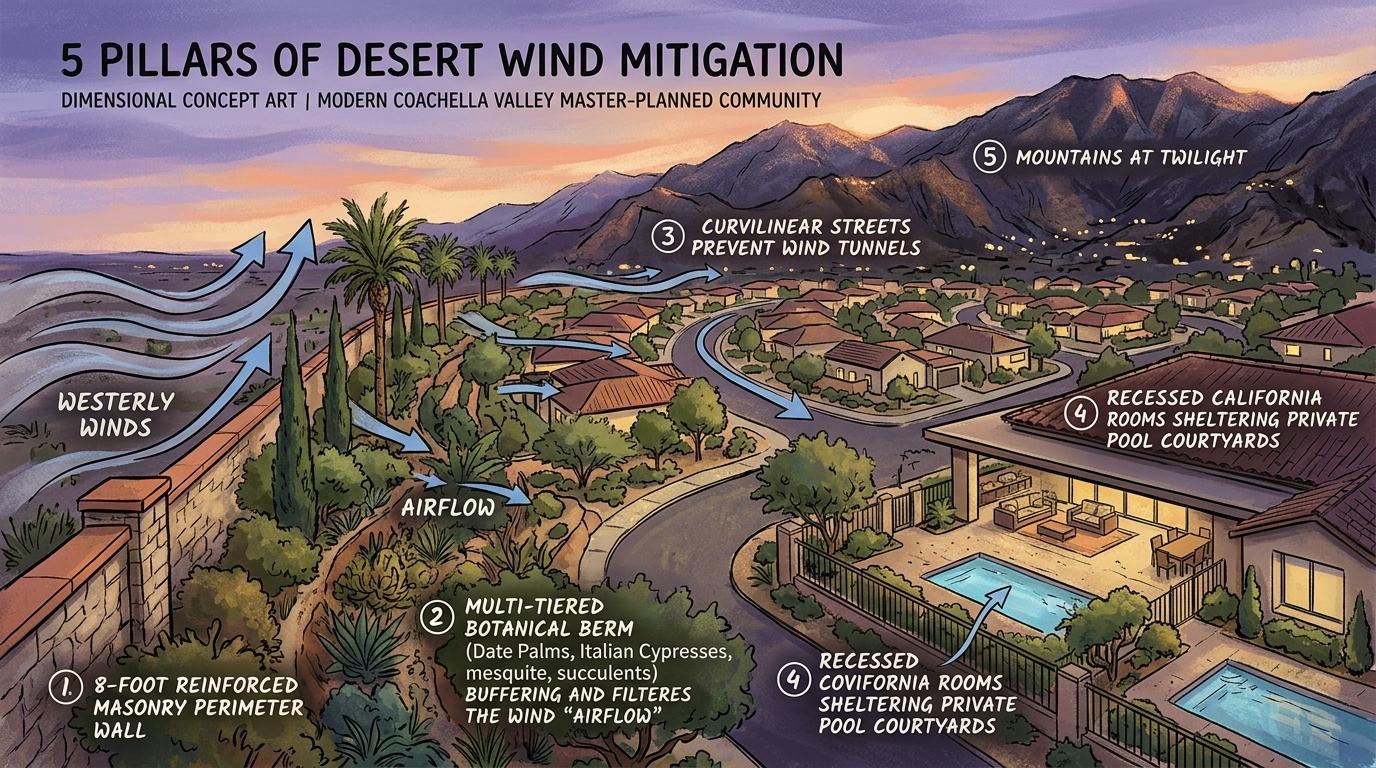
The 5 Pillars of Desert Wind Mitigation: solid masonry walls, multi-tiered botanical berms, curvilinear street plans, recessed California Rooms, and airtight envelopes.
1. Pillar 1: 6-to-8-Foot Engineered Masonry Perimeter Walls
Concrete Masonry Unit (CMU) perimeter walls anchored with steel rebar footings act as solid deflection barriers, forcing incoming wind currents upward and creating a 15-to-25-foot calm shadow zone along community edges.
2. Pillar 2: Multi-Tiered Botanical Landscaping Windbreak Berms
Earthen berms planted with tall date palms, Italian cypresses, palo verde, and desert shrubs act as porous baffles, naturally filtering and diffusing wind energy rather than creating turbulent downdrafts.
3. Pillar 3: Curvilinear Streets & Cul-de-Sac Geometry
Master-planned curved roadways, offset intersections, and cul-de-sacs break up linear wind vectors, preventing gusts from funneling into high-velocity wind tunnels common in grid tracts.
4. Pillar 4: Architectural Lot Siting & Covered California Rooms
Signature covered California Rooms structurally recessed between exterior home walls create sheltered three-sided outdoor sanctuaries for year-round dining and poolside relaxation.
5. Pillar 5: Precision Weatherization & Dual-Pane Low-E366 Envelopes
Polyurethane foam door sealing and dual-pane Low-E366 Argon glass eliminate rattling, whistling, and dust intrusion, keeping indoor spaces quiet and climate-controlled.
Wind Mitigation Comparison: Gated Master Plan vs. Open Resale Tract
Understanding the microclimate differences between older open subdivisions and modern master-planned communities illustrates the huge lifestyle advantage of buying new:
In older 1970s–1980s tract developments, long straight streets parallel to prevailing winds act as velocity channels, and low wooden fences fail to stop blow-sand from coating patios and pools. Outdoor dining is often abandoned for weeks during breezy spring months.
In a D.R. Horton master plan, multi-tiered botanical berms, solid perimeter walls, and recessed California Rooms preserve pool cleanliness and allow families to enjoy over 300 days of undisturbed outdoor desert living.
Outdoor Living Quality Comparison
- Patio Usability: 300+ days/year of outdoor living vs. frequent seasonal disruption in unbuffered tracts.
- Pool Cleanliness: Minimal skimmer cleaning and mirror-flat pool water protected from blow-sand.
- Acoustic Peace: Silent indoor environments without window whistling or rattling drafts.
- Perimeter Security & Privacy: Gated entrances combined with 8-foot masonry boundaries.
Community Spotlights: 4 Desert Communities & Wind Engineering
D.R. Horton's four featured Coachella Valley neighborhoods offer tailored wind mitigation engineering across diverse microclimates:
1. The Enclave at Capistrano — La Quinta, CA (Featured Community)
Located at 57-435 Crown Valley Court near PGA West. Single-story luxury priced from the low $700s with 2,348 to 3,003 sq. ft. (3–4 Beds / 2.5–3.5 Baths / 2–3 Car Garages).
- •Santa Rosa Mountain Natural Shield: Massive rock faces block northern and western wind vectors.
- •100% Single-Story Luxury Enclave: Recessed California Rooms and private courtyard entries.
- •Calmest Microclimate in the Valley: Unrivaled poolside tranquillity beneath towering foothills.
2. The Collection at Sage — Palm Desert, CA
Located at 73298 Warhol Lane in central Palm Desert off Gerald Ford Drive. Priced from $626,162 with 1,750 to 2,312 sq. ft. (3–4 Beds / 2 Baths / 2-Car Garage).
- •Mid-Valley Gated Perimeter Walls: Solid CMU walls paired with lush palm and shrub berms.
- •Gated Resort Amenities: On-site heated pool, spa, clubhouse, and fitness center.
- •Minutes to El Paseo: Premier dining and shopping in the heart of Palm Desert.
3. Dolfina — Indio, CA
Located at 49140 Heron Place near the Empire Polo Club. Priced from the $610s with 1,890 to 2,537 sq. ft. (4–5 Beds / 3–4 Baths / 2–3 Car Garages).
- •Calm East-Valley Microclimate: Located well southeast of the pass corridor with mild breezes.
- •Deep 8,000+ Sq. Ft. Lots: Generous rear setbacks protected by perimeter masonry walls.
- •Imperial Irrigation District Power: Ultra-low electricity rates keep summer cooling costs low.
4. The Collection at Campanile — Cathedral City, CA
Located at 232 Via Genova just minutes from downtown Palm Springs. Priced from $587,199 with 1,913 to 2,929 sq. ft. (3–5 Beds / 2–4 Baths / 2-Car Garage).
- •Engineered Structural Envelopes: High-wind structural design and Low-E366 acoustic glazing.
- •Curvilinear Interior Street Plan: Road curvature diffuses wind speed across the neighborhood.
- •10 Minutes to Palm Springs Airport (PSP): Turnkey smart home convenience.
Broker Stacy King's 6-Point Wind Due Diligence Checklist
When evaluating homesite locations and community orientation, Broker Stacy King guides buyers through six microclimate checkpoints:
Stacy King's Wind Mitigation Due Diligence Checklist
- 1. Microclimate Corridor Audit: Evaluate valley geographic position relative to the San Gorgonio Pass and mountain shadow zones.
- 2. Homesite Sun & Prevailing Wind Orientation: Align backyard patio to capture winter sun while shielding from spring wind vectors.
- 3. Perimeter Masonry Wall Height Check: Confirm 6ft-8ft reinforced block wall buffers between community edge and open desert.
- 4. California Room Recess Inspection: Verify covered patio design provides 3-sided architectural shelter for outdoor dining.
- 5. Botanical Berm Maturity Audit: Review HOA landscape master plans for date palms, cypresses, and wind-filtering hedge species.
- 6. Dedicated Broker Advocacy: Register Broker Stacy King on your first visit to protect your construction and contractual rights at zero extra cost.
"Desert wind shouldn't force you indoors. By combining the natural mountain shield of South La Quinta with engineered masonry walls and recessed California Rooms, you enjoy peaceful outdoor entertaining year-round. Give King a Ring!"
— Stacy King, Real Estate Broker
Frequently Asked Questions (FAQ) About Coachella Valley Desert Wind
Here are answers to the top questions buyers ask Broker Stacy King regarding desert microclimates, windbreaks, pool maintenance, and sheltered homesite selection across Greater Palm Springs.
Which areas of the Coachella Valley have the least wind?
The southern and eastern portions of the valley—specifically south La Quinta (such as The Enclave at Capistrano), south Palm Desert, and Indio (such as Dolfina)—experience significantly less wind than areas directly adjacent to the San Gorgonio Pass (such as north Palm Springs and Desert Hot Springs), because they are shielded by the massive physical mass of the Santa Rosa Mountain range.
How do landscaping berms reduce wind speed?
Unlike a flat, solid wall which can create turbulent downdrafts on its lee side, an earthen berm planted with multi-tiered trees (palms, cypresses, mesquite) acts as a porous baffle. It slows, absorbs, and filters wind energy gradually, reducing wind speed across the neighborhood by up to 50% to 70% without creating turbulence.
What is a covered California Room and how does it protect against wind?
A California Room is an outdoor living space structurally built under the home's main roofline, typically recessed between exterior home walls. This three-sided architectural shelter blocks cross-breezes, allowing homeowners to enjoy outdoor dining, watch TV, and relax by the pool even during breezy spring afternoons.
Will windblown sand scratch my windows or ruin my pool?
In modern master-planned communities with perimeter masonry walls and extensive paved/landscaped ground cover, airborne blow-sand is stopped at the community boundary. Furthermore, modern homes utilize scratch-resistant, heavy-gauge dual-pane Low-E366 glass that provides complete acoustic and thermal sealing.
Why should I use Broker Stacy King when choosing a homesite orientation?
Builder sales agents will not explain how wind patterns vary across individual lots within a subdivision. Having Broker Stacy King represent you as your dedicated buyer's broker costs you zero dollars extra (commissions are paid from the builder's marketing budget) and provides you with an experienced 20+ year desert expert who analyzes lot angles, patio recesses, and mountain wind shadows before you sign.
Enjoy 300+ Days of Calm Outdoor Living: Connect with Broker Stacy King
Your desert backyard should be a tranquil, serene oasis where you spend your mornings sipping coffee, your afternoons lounging by a glass-calm pool, and your evenings dining al fresco under starry desert skies. Don't leave your outdoor living comfort to chance by settling for an unprotected open-grid resale tract. Step into the civil engineering, masonry perimeter protection, and sheltered luxury of modern new construction.
Explore natural foothill mountain protection at The Enclave at Capistrano in La Quinta, central gated resort elegance at The Collection at Sage in Palm Desert, spacious calm living at Dolfina in Indio, or smart engineered design at The Collection at Campanile in Cathedral City. Broker Stacy King brings over 20 years of builder expertise and dedicated client advocacy to your corner.
Showing hours are Wednesday through Sunday, 10:00 AM – 6:00 PM. Call 760-902-6907 or email agentstacyking@gmail.com today to schedule your private VIP community tour and microclimate wind consultation at zero cost to you!
"Give King a Ring at 760-902-6907 before visiting any Coachella Valley sales office to secure your 100% free buyer representation!"
— Stacy King, Real Estate Broker

Stacy King
DRE 01458045
Real Estate Broker & New Home Specialist
CA DRE #01458045 | Over 20 Years Experience | 1,000+ Homes Sold
Stacy King brings over two decades of new construction leadership, builder contract expertise, and localized desert real estate knowledge to help buyers find their dream home in Greater Palm Springs.